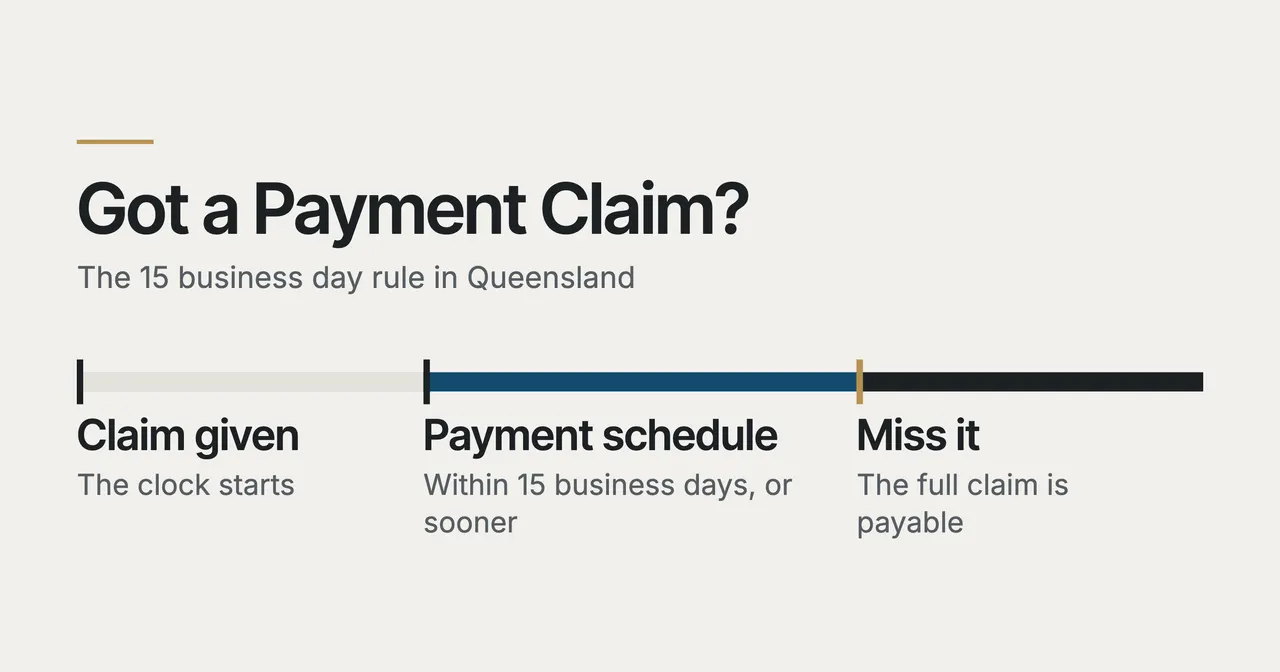
If you receive a payment claim for construction work in Queensland, you must answer it with a payment schedule within the time your contract allows or 15 business days, whichever ends first, unless you pay the full amount by the due date. Miss that deadline and the full amount claimed becomes payable on the due date, whatever you think of the work. The claimant can then sue for it as a debt or apply for adjudication, and you lose most of your chance to argue about the work.
The rules are in chapter 3 of the Building Industry Fairness (Security of Payment) Act 2017 (the BIF Act). This article explains them as at 2 October 2026, for the owner, developer or facility manager who receives the claim.
Who This Applies To
The Act covers almost every contract for construction work in Queensland, written or not: new builds, refurbishments, fit-outs, maintenance, and the consultants' services that go with them. It applies whoever you are, including an owner who has never held a building licence. The main exception is a contract with a resident owner for domestic building work on the home they live in or plan to live in. This article is about commercial work.
What Counts as a Payment Claim
Under section 68, a payment claim is a written document that:
- identifies the construction work, or the goods and services, it relates to;
- states the amount claimed; and
- requests payment of that amount.
A document with the word "invoice" on it counts as a request for payment. Nothing in section 68 requires the claim to mention the Act, so treat every invoice from your builder or a direct trade contractor as a payment claim.
Each claim is tied to a reference date: the date the contract sets for claims or, if it sets none, the last day of each month, starting with the month work begins. Only one claim can be made for each reference date, although it can repeat amounts from earlier claims. A claim other than the final one must be given within the contract's period or six months after the work was last done, whichever is longer.
If your contractor is a head contractor with subcontractors, its claim to you must come with a supporting statement declaring that its subcontractors have been paid, or listing those who have not and why. A claim without one is still a valid claim, but the head contractor commits an offence by leaving it out.
The Deadline: 15 Business Days, or Sooner
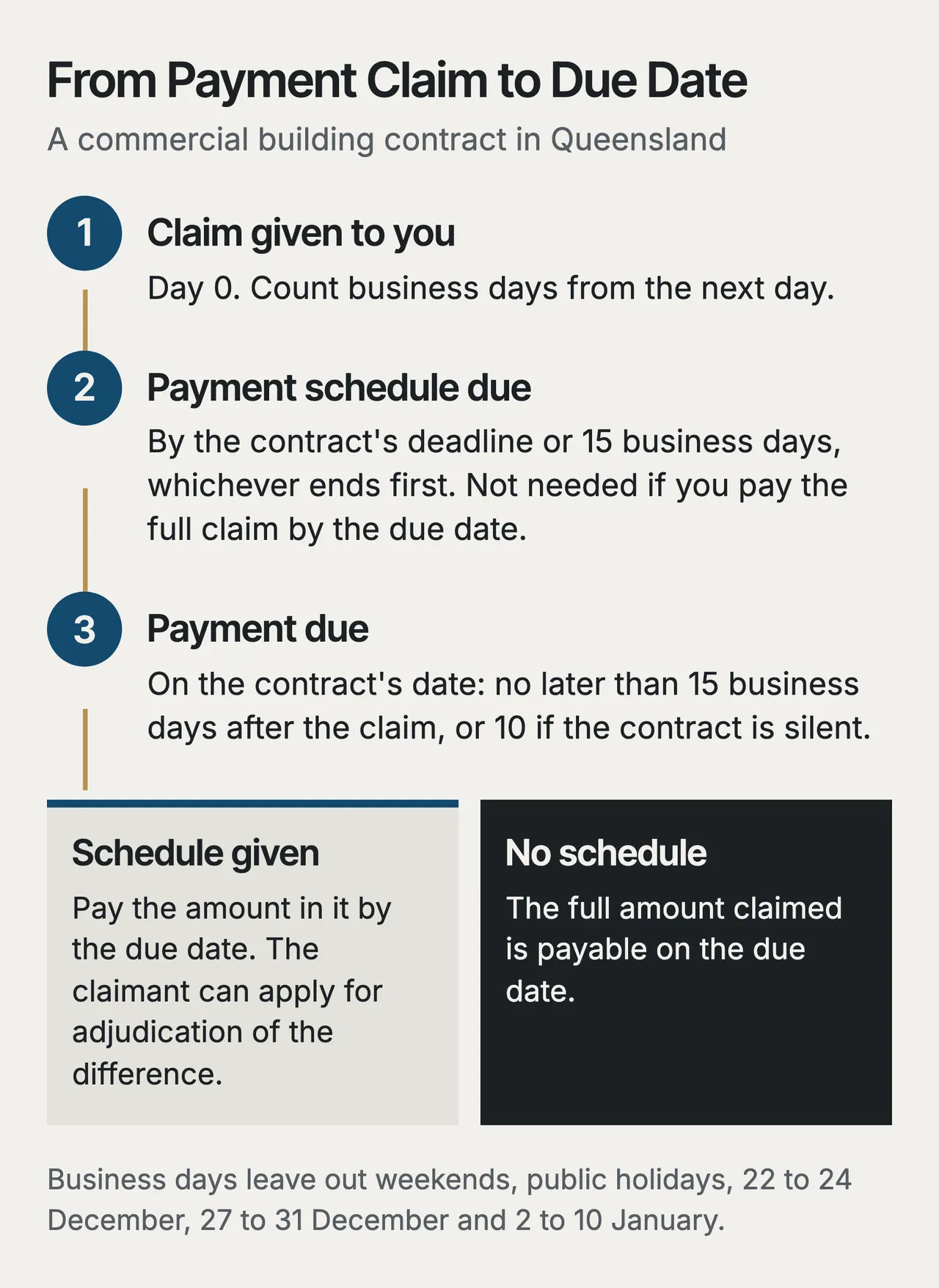
Section 76 gives you until whichever of these ends first:
- the period your contract sets for a payment schedule; or
- 15 business days after the claim is given to you.
If your contract says 10, you have 10.
Business days under the Act leave out weekends, public holidays, and three blocks over Christmas: 22 to 24 December, 27 to 31 December and 2 to 10 January. Count from the day after the claim arrives.
| Claim given to you | Last day for the payment schedule |
|---|---|
| Monday 2 November 2026 | Monday 23 November 2026 |
| Friday 11 December 2026 | Thursday 21 January 2027 |
The clock starts when the claim is given to you, not when the right person reads it. A notice can be given in the way the contract allows, and a contract can allow email. A claim that sits in a shared inbox or with a site manager for a week has already used a third of your time.
What a Payment Schedule Must Say
Under section 69, a payment schedule is a written document that:
- identifies the payment claim it responds to;
- states the amount you propose to pay, which can be nothing; and
- if that is less than the claim, says why, including your reasons for withholding any payment.
Put every reason in the schedule: defective work, work not done, a variation you have not agreed, a backcharge or a deduction the contract allows. Give enough detail for the claimant to understand each one. If the claim goes to adjudication, your response cannot raise reasons the schedule did not include, and the adjudicator must ignore them.
You must then pay the amount you proposed by the due date.
When the Payment Itself Is Due
The due date is the date the contract sets for payment. If the contract is silent, payment is due 10 business days after the claim is made.
A building contract cannot push it out far. Under section 67W of the Queensland Building and Construction Commission Act 1991, a term in a commercial building contract is void to the extent it allows payment of a progress payment later than 15 business days after the claim. The limit for subcontracts and construction management trade contracts is 25 business days (section 67U). A term that breaks the limit is void, and the BIF Act then applies the default: payment is due 10 business days after the claim. A "pay when paid" clause, which ties your payment to money you receive from someone else, has no effect and leads to the same default. If a lender funds the project, its drawdown timetable has to fit inside these dates; our article on cost plus contracts and lenders covers how.
The payment can fall due before the last day for the schedule. Where the contract is silent, payment is due after 10 business days and the schedule after 15. Section 76 lets you skip the schedule only if you pay the full claim by the due date, so plan to decide well inside the shorter time.
Interest runs on any amount unpaid after the due date. Under a contract for building work, the rate is 10% a year plus the Reserve Bank's published 90 day bill rate, or the contract's rate if that is higher.
What Happens If You Miss It
If you give no schedule in time, section 77 makes you liable to pay the full amount claimed on the due date. That is the claimed amount, not the value of the work. The claimant can then:
- sue for the unpaid amount as a debt. It must first give you a warning notice and wait 5 business days, which is your last chance to pay before court. In court you cannot bring a counterclaim or raise a defence arising under the contract;
- apply for adjudication. You cannot lodge an adjudication response at all;
- suspend work, two business days after giving written notice, until it is paid and for 3 business days after.
Failing to give a schedule also carries a maximum penalty of 100 penalty units, and is grounds for disciplinary action by the QBCC against a licensee.
Your rights under the contract survive: a later court case over the work must allow for what you paid and can order money returned. But you pay first and argue later.
How Adjudication Works
Adjudication is the Act's fast way to decide a disputed claim. The QBCC runs the Adjudication Registry, which refers each application to a registered adjudicator.
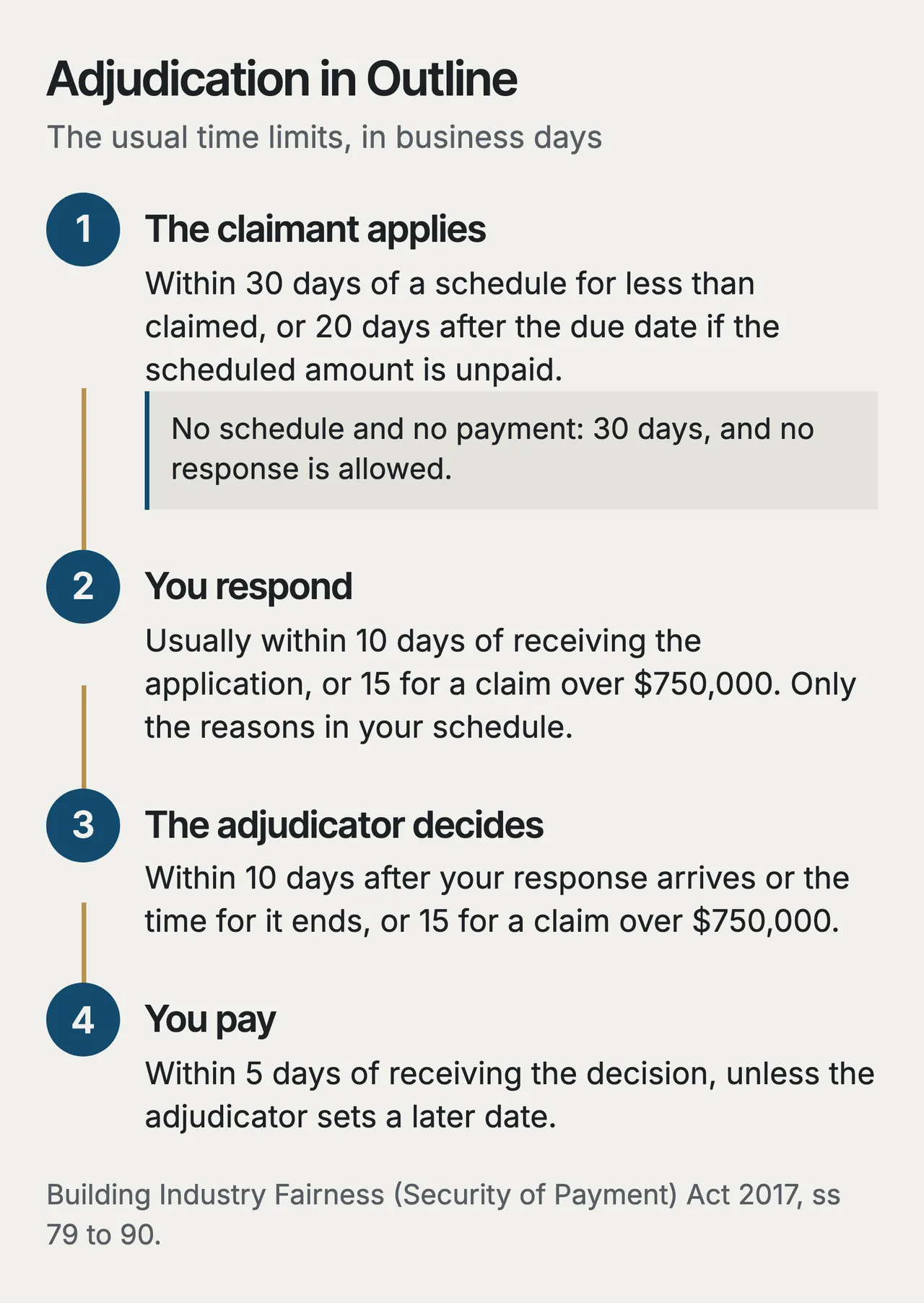
The claimant applies within these limits:
- 30 business days after receiving a schedule for less than the claim;
- 20 business days after the due date, if you gave a schedule but did not pay the amount in it; or
- 30 business days after the later of the due date and the last day for a schedule, if you gave no schedule and did not pay the claim.
If you gave a schedule, you can respond. For a claim of $750,000 or less, the response is due within the later of 10 business days after you receive the application and 7 business days after you are told the adjudicator has accepted it. For a claim over $750,000 it is 15 and 12 business days. You can apply to the adjudicator for up to 15 more, but it is not automatic. The application must be in writing, give your reasons for needing the time, and be made within 5 business days after you receive the application or 2 business days after the acceptance notice, whichever is later (section 83). The adjudicator decides whether to grant it and for how long. The response can expand on your reasons but cannot add new ones.
The adjudicator decides on the Act, the contract, the claim, the schedule, the parties' submissions and any inspection. The decision is due within 10 business days after the response arrives or the time for it ends, or 15 for a claim over $750,000, unless the parties agree to more time. You must pay any amount decided within 5 business days of receiving the decision, or by a later date the adjudicator sets. The penalty for not paying is up to 200 penalty units, and the claimant can file the adjudication certificate in court as a judgment debt. Once the certificate is filed, a head contractor can also register a charge over the land where the work was done, if you or a related entity own it.
Practical Steps for an Owner's Team
- Name one address for claims. Write it into the contract as the place notices are given, and make sure someone reads it every day.
- Date-stamp every claim on arrival. Diary the schedule deadline at once, using the contract's period if it is shorter than 15 business days, and the payment due date beside it.
- Know who assesses it. Your superintendent, quantity surveyor or project manager should check the claim against the contract and the work on site in the first week, not the third.
- When in doubt, send a schedule. If there is any chance you will not pay the full amount by the due date, give a schedule. It costs little and keeps your rights.
- Give every reason, with its evidence. Refer to the clause, the inspection, the photos or the defect notice. A reason left out now cannot be added in adjudication.
- Pay what you schedule, on time. Paying the undisputed amount by the due date keeps the dispute to the amount in question.
- Plan for holidays. Most offices close for longer than the Christmas days the Act leaves out, so arrange cover for the days that still count.
- Check the supporting statement on a head contractor's claims, and ask for one if it is missing.
- Act on the same day if an adjudication application arrives. Your response time is short and starts when you receive the application.
For a specific dispute, get advice from a construction lawyer or talk to the QBCC early, before the deadlines run.