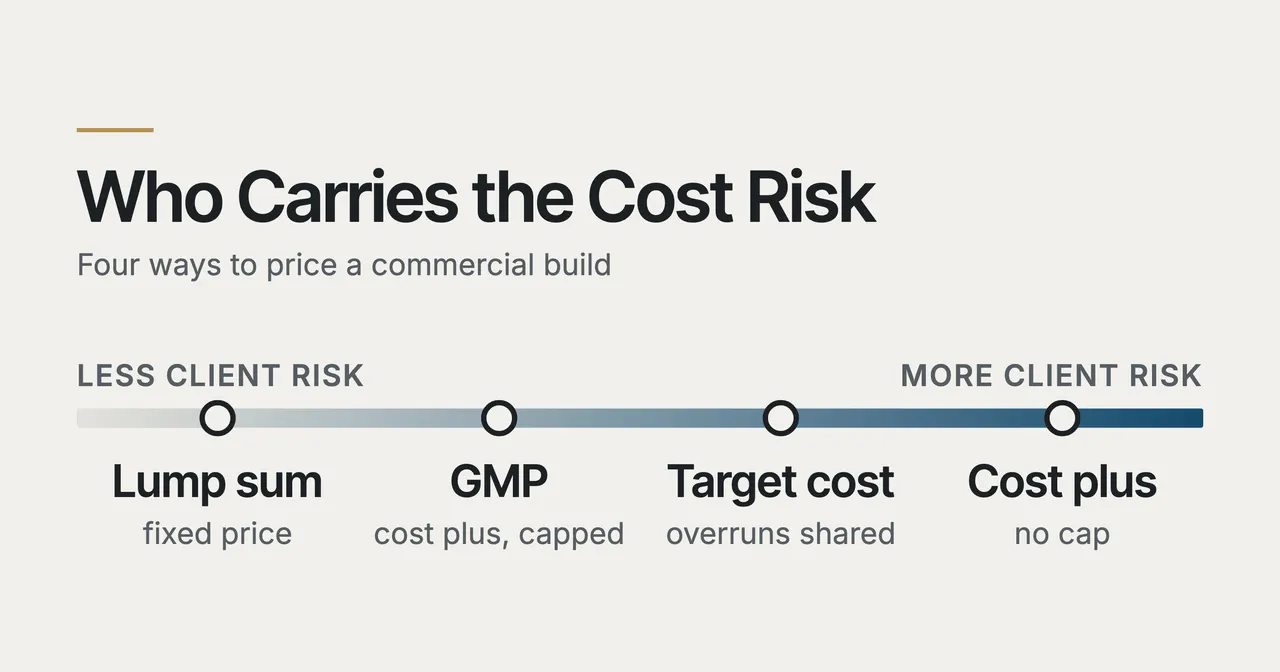
A cost plus contract pays the builder its actual costs plus an agreed fee, so the final price is not known when the contract is signed. That uncertainty is what a lender looks hard at. The answer is structure: a guaranteed maximum price (GMP) that caps the cost of the agreed scope, open-book records, a quantity surveyor (QS) on the client's side who checks every claim, and a lender's QS who certifies each drawdown against the cost to complete. Set up this way, cost plus gives a lender checked, current figures rather than a blank cheque.
This article is for owners and developers of commercial projects in Queensland. Cost plus contracts to build a house or duplex, or to renovate a home, follow separate rules, in schedule 1B of the Queensland Building and Construction Commission Act 1991.
Four Ways to Price a Commercial Build
| Method | What the Client Pays | Who Carries an Overrun | Suits |
|---|---|---|---|
| Lump sum | An agreed price, which moves only as the contract allows | The contractor, apart from variations and the risks the contract gives the client | Complete, accurate documents and a clear scope |
| Cost plus | Actual costs plus an agreed fee, with no maximum | The client | A scope or design that is not settled, or work that must start early |
| Cost plus with a GMP | Actual costs plus the fee, up to a ceiling | The contractor, above the ceiling | A design developed enough for a firm estimate |
| Target cost | Actual costs plus the fee, adjusted by the agreed shares of savings and overruns | Both, in the agreed shares, up to any cap on the contractor's share; the client above it | Work whose scope is hard to price |
Standards Australia's general conditions of contract, AS 4000, is written for a lump sum or agreed rates. The current edition, AS 4000:2025, replaced the 1997 edition in June 2025 and keeps its balance of risk. Neither AS 4000 nor the design and construct form, AS 4902, has a GMP mechanism. On a private project, a GMP is set out in special conditions to a standard form or in a contract drafted for the job.
Why Lenders Look Hard at Cost Plus
A construction lender funds a project against a budget. Its own QS checks, at every claim, that the money left in the loan still covers the cost to finish the job. If it does not, the developer tops up the gap before the lender pays more.
A fixed contract price gives the lender's QS a firm figure to test against. Cost plus without a cap does not: the cost of the work can keep rising. Lenders' attitudes to cost plus vary, but a lender's QS reviews the building contract before funding starts, and financiers often ask for changes before they accept a contract.
How a Guaranteed Maximum Price Works
A GMP puts a ceiling on a cost plus contract. The client pays actual costs plus the fee up to the ceiling, and the contractor pays any cost above it. If the final cost comes in under, the saving stays with the client or is shared, as the contract says. Government contracts that use a cap, such as the Department of Defence's GMP head contract, give the contractor an agreed share of the saving.
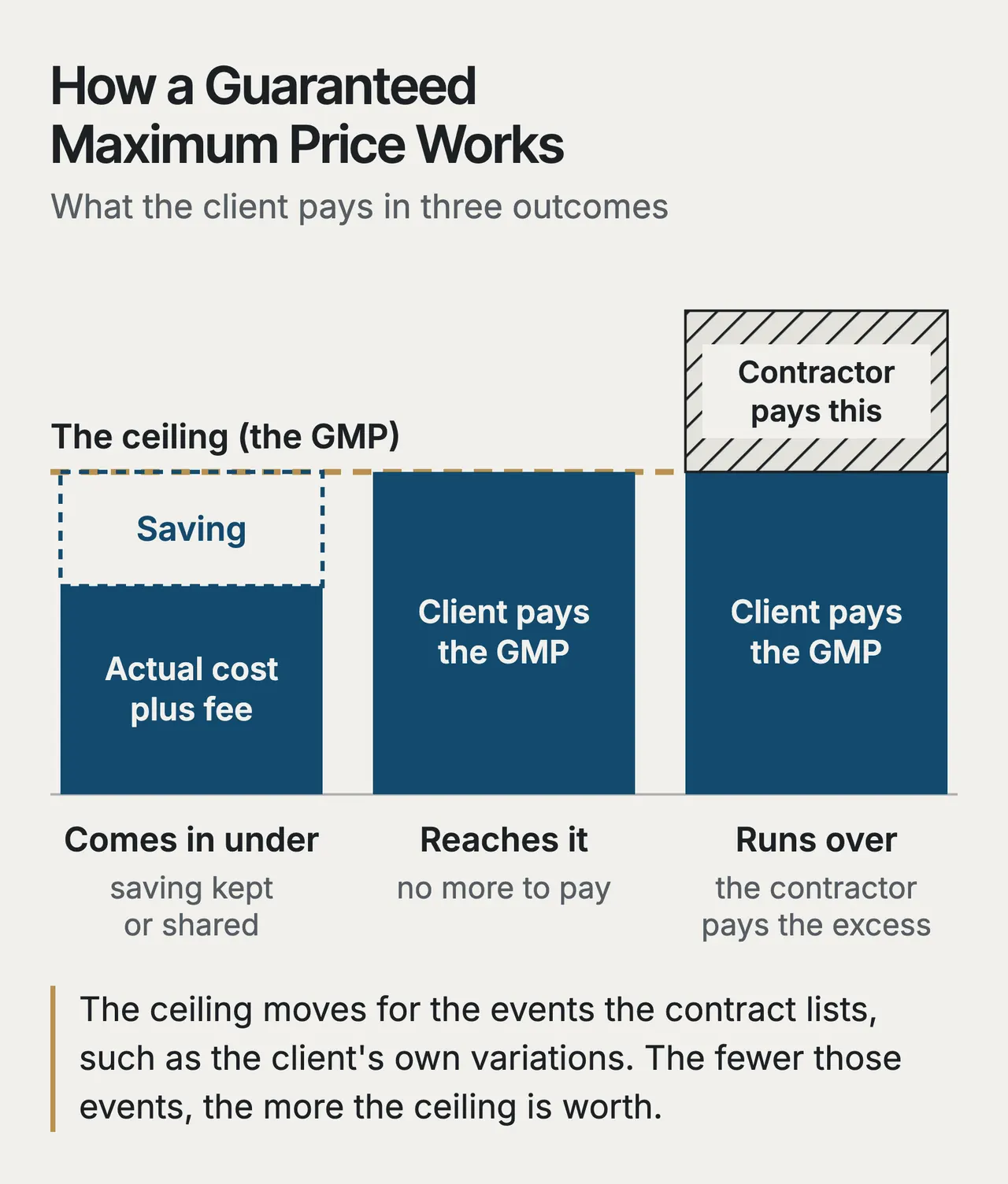
The ceiling caps the price of the agreed scope. It is not an absolute guarantee. Like a lump sum, it moves for the events the contract lists, such as the client's own variations. The client pays no more than the GMP as adjusted under the contract.
What Makes a GMP Hold
Three things decide how much a GMP protects the client.
- How developed the design is when the cap is fixed. Queensland Government guidance has a managing contractor offer its guaranteed sum at the end of the first stage. It warns that asking for the offer very early may lead the contractor to price or exclude risks that the rest of that stage's work would have dealt with.
- What sits inside it. Exclusions sit outside the cap, and allowances for work not yet priced may be adjusted to their actual cost. Ask what the cap really fixes: the longer the list of exclusions and allowances, the less it covers.
- What can move it. Every adjustment event the contract lists. The fewer and tighter they are, the firmer the number.
A cap negotiated with one contractor is also set without price competition. Have your own QS test it before you agree it.
Target Cost Shares the Risk but Does Not Cap It
Under a target cost arrangement, the parties agree a target: the expected cost at completion. Savings and overruns against it are split in shares agreed project by project. It rewards the contractor for saving money, but it is not a price cap. Once any limit on the contractor's share of an overrun is reached, the owner pays the rest. On its own, target cost does not cap the owner's cost or the lender's exposure. Only a maximum price does that.
Open Book Only Works If Someone Reads It
Open book means the client can see and audit the contractor's actual costs: subcontracts and invoices, labour, materials and plant. The contract should say which costs can be claimed, give audit rights and a right to correct earlier payments, and require records that can be audited.
The right is only as good as the review. Government guidance says the client must understand the scope and design well enough to question the costs, with its own or outside expertise, and warns that an open book can simply be a transparent costing of an inefficient offer.
Two Quantity Surveyors, Two Jobs
A financed cost plus job usually has two QS roles.
- The client's QS advises the client and assesses each of the contractor's claims against the cost records.
- The lender's QS reports to the lender. Before funding, it reviews the building contract, the budget and contingency, the programme and the approvals. During construction, it assesses each progress claim, usually monthly on a development facility, and reports the cost to complete.
One firm can do both only if the client and the lender agree.
How Drawdowns Follow Certified Work
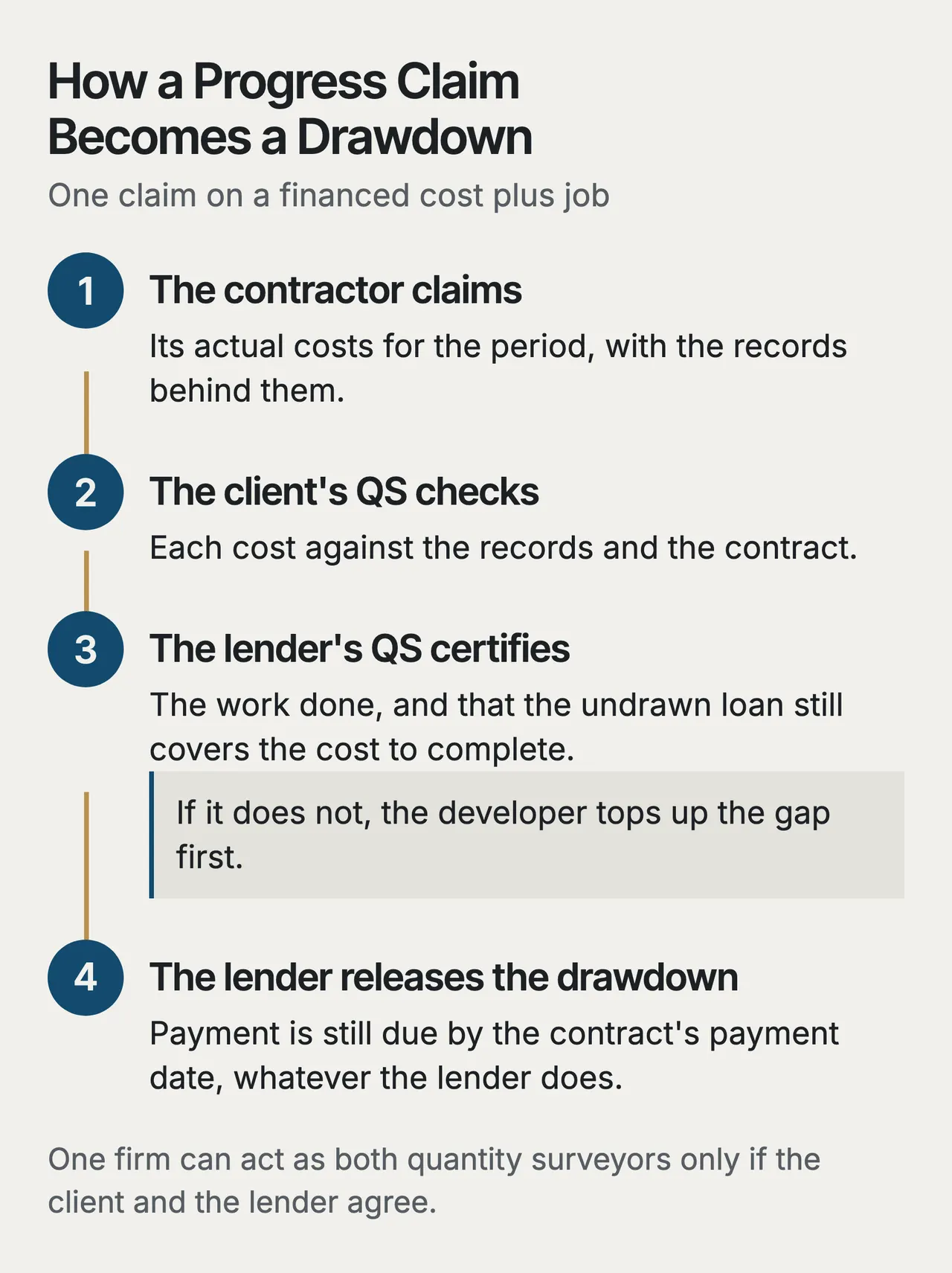
Construction loans are drawn progressively against certified work. At each claim, the lender's QS checks that the undrawn loan still covers the cost to complete, and the developer tops up any shortfall before the lender pays more. A GMP narrows that risk but does not remove it: the GMP can still move for the listed events, and the loan funds the whole development, not just the building contract.
Queensland Rules That Apply
In Queensland, progress payments under construction contracts are governed by the Building Industry Fairness (Security of Payment) Act 2017. The contractor gives a payment claim. The client answers with a payment schedule within the time in the contract or 15 business days, whichever ends first, stating the amount it will pay and, if that is less than the claim, why. If no schedule is given, the full amount claimed becomes payable on the due date. Cost plus progress claims are generally made under the Act, so the contract should spell out how each claim is valued. The Act's payment rules apply to the building contract, not the loan: a drawdown is the lender advancing money to the developer, not a progress payment under the Act. The lender's timetable has to fit inside the contract's payment times. A clause that makes payment wait for the drawdown has no effect under the Act. A contract with such a clause is treated as setting no payment date, so each payment falls due 10 business days after its claim.
As at September 2026, a head contract with a private owner needs a project trust if its price is $10 million or more (excluding GST) and it meets the Act's other conditions. For the State or a hospital and health service, the threshold is $1 million. An extension to smaller private contracts has been paused since early 2025. Where the price cannot be fixed at signing, as under cost plus, the Act tests the threshold against a reasonable estimate.
A contract signed under the threshold can still cross it. The Act treats a rise in the price as an amendment. Once the price has risen by 30% or more and reached a level that would have needed a trust at signing, a trust is needed from then on, unless practical completion is expected less than 90 days after the rise. A job estimated at $8.5 million, for example, crosses the line when its price reaches $11.05 million, 30% above the estimate, not when it passes $10 million. If a project trust is required, the client pays each progress payment into the head contractor's project trust account. The trust rules change where the money goes, not how a claim is valued.
When Cost Plus Is the Right Choice
Cost plus suits a project where the scope or design is not settled, the risks are hard to price or the interfaces are complex. It suits work that must start before the design is finished, such as early works in the first stage of a two-stage contract. It also suits alterations where much of the work cannot be costed until it is opened up.
It is the wrong choice when the documents are complete and the scope is clear. A lump sum can then give strong price certainty. It is also a poor fit for a client who cannot check the costs.
What to Put in Front of Your Lender
- The GMP, what can adjust it, and what sits outside it.
- How the fee is worked out, and how any saving is shared.
- The open-book and audit rights, and the records the contractor must keep.
- Who checks the costs for you: your own QS or cost manager.
- The reports the lender's QS will receive, and whether one QS will act for both you and the lender.
- Whether the head contract needs a project trust, at signing or if the price rises.
Have your own lawyer and QS review the contract before you sign it.