The V-Method
Our operating system for commercial construction.
- —
- Method Overview
V-Method
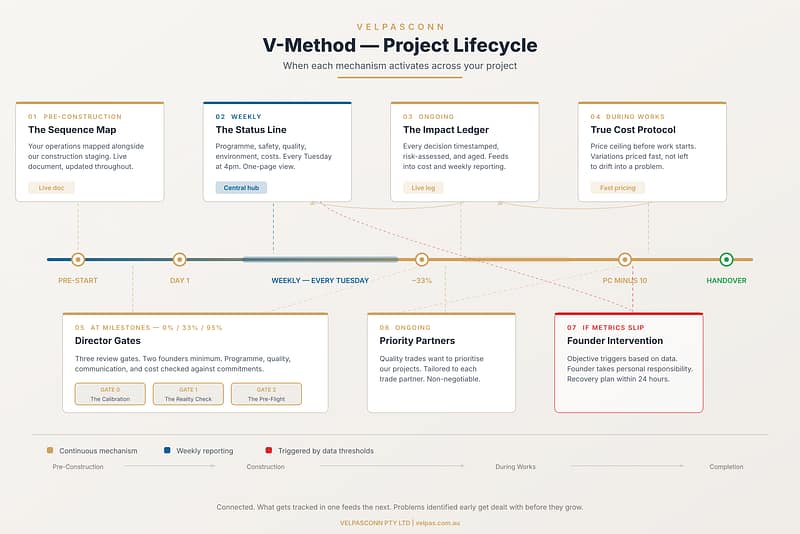
The V-Method is how we run every project. We built it before we took on our first project.
It comes from decades of combined experience watching the same problems repeat on construction sites: communication that breaks down, costs that drift without warning, planning that looks good on paper but falls apart on site, and problems that sit too long before anyone acts.
The V-Method ties together what is required under the head contract with the things we have learnt need to happen but usually don’t.
Talk to One of the Founders
1
Pre-Construction
The Sequence Map
1
Pre-Construction
The Sequence Map
Every project has a staging plan. On most projects, it lives in a programme the client can’t easily follow, and the real-world constraints (trading hours, IT migration, staff access, car park closures) get communicated verbally or not at all.
Before we start, we map your operational constraints alongside our construction staging into something your team can read and share. For new builds, we also map external dependencies: power, data, council, water. It is a live document that feeds into our weekly reporting, so you can see how staging decisions are playing out throughout the project.
2
Weekly
The Status Line
2
Weekly
The Status Line
Once a week, same day, same format. You get a one-page project health record covering programme status, safety, quality, environmental compliance, pending decisions, risks, and cost movements.
We issue it from day one. It covers the contractual requirements and what is brewing that hasn’t become a formal issue yet. A founder reviews it before it goes out. Available as a PDF you can share directly with your stakeholders, your lender, or your board. Same format every week, so you can track how things are trending.
3
Ongoing
The Impact Ledger
3
Ongoing
The Impact Ledger
Every project generates site instructions, RFIs, and meeting minutes. Things still get lost. A direction gets given in an email thread with the wrong subject line. Three months later, it is “I mentioned that” or “I didn’t know it would have that impact.”
Every decision, instruction, and change gets logged with a timestamp, a unique reference, and a clear record of who instructed what. Each entry is risk-assessed and aged by days outstanding so nothing drifts. It feeds through to our cost tracking and weekly reporting, so a decision made on site on Monday is visible in the project health record by Tuesday. When something has consequences, you will know early enough to act.
4
During Works
True Cost Protocol
4
During Works
True Cost Protocol
Variation pricing is one of the biggest friction points in construction. A change comes up mid-programme. The client asks for a price. The builder says they will get to it, but it isn’t a priority until it is about to hit the critical path. By then, the conversation has shifted from “how much will this cost?” to “who is responsible for the delay?” What should be a simple pricing exercise becomes a relationship problem.
Our approach is to turn variation pricing around faster. Most variations aren’t complex. They sit unprioritised. We have a system for processing and pricing changes so you get the numbers you need to make a decision. For simple variations, our target is a price back to you within 72 hours. For complex variations that need more time, we will be upfront about the timeline and what is driving it. Either way, pricing won’t drift until it becomes a problem. You will have cost information early enough to act without stalling the programme.
5
0% / 33% / 95%
Director Gates
5
0% / 33% / 95%
Director Gates
Most builders have some form of internal review. They tend to happen ad hoc, cover whatever seems relevant at the time, and the client rarely knows about them.
We set three review gates at defined milestones, attended by at least two founders. Each gate checks programme, quality, communication, and cost against our commitments. You will know when they are scheduled and what we are looking at.
Gate 0: The Calibration (Pre-Start): “Is every system ready for Day 1?”
Gate 1: The Reality Check (~33% Complete): “Is this project really on track, or are we just saying it is?”
Gate 2: The Pre-Flight (PC Minus 10 Days): “Would we pay for this building in its current state?”
6
Ongoing
Priority Partners
6
Ongoing
Priority Partners
Good trades are the backbone of every project. But too often, they get called to sites that aren’t ready, wait too long for payment, and get treated as replaceable. The best ones eventually stop prioritising the builders who operate that way, and the project is what suffers.
Priority Partners is how we manage trade relationships. We pay on time. We issue purchase orders before variation work starts so trades aren’t carrying the risk. We check site readiness before we call anyone in: if a zone isn’t ready, we don’t waste their time. We ask every trade partner what they need from us to do their best work, and we build the coordination around that.
The result for you: trades that want to be on your project, quality work because they are set up to deliver it, and fewer programme disruptions from rework or no-shows. All three founders are aligned on this. It is non-negotiable.
7
If Metrics Slip
Founder Intervention
7
If Metrics Slip
Founder Intervention
Escalation processes exist on most projects. But they usually rely on someone deciding the problem is serious enough to raise. By the time it reaches someone who can make a call, the problem has grown and the options have narrowed.
We define objective triggers at the start of each project: specific thresholds for programme slippage, cost variance, and unanswered client correspondence. When a threshold is breached, a founder gets pulled in directly. No judgement call required. The founder takes personal responsibility and issues a recovery plan within 24 hours.
Benefits
None of these are revolutionary on their own. Staging plans, weekly reports, decision logs, variation tracking, escalation procedures. They all exist in some form on most projects. The difference is that ours are connected. What gets tracked in one feeds into another. Problems identified early get costed, reported, and escalated before they have time to grow.
The V-Method isn’t a guarantee that nothing will go wrong. Construction is complex and unpredictable. What it does is make sure that when something happens, it gets picked up quickly, the right people know about it, and it gets dealt with before it becomes expensive.
That is what an operating system does. It ties the loose ends together.
Implementation
Want to See How It Works?
- —
- FAQ Section
Frequently Asked Questions
- Q.
- Does the V-Method add cost to the project?
- A.
- The V-Method is built into how we work. The cost of running these systems is negligible compared to the cost of a variation blowout, a programme overrun, or a trade dispute that could have been avoided.
- Q.
- Can I use the Status Line for my own reporting?
- A.
- Yes. It is designed as a one-page summary you can share with your stakeholders, include in board packs, or forward to your lender. We can customise the format to suit your reporting requirements.
- Q.
- What happens if a project fails a Director Gate?
- A.
- Work at that milestone is held for review. The founders assess the issue, a rectification plan is documented and agreed, and the project moves forward once it passes. The gate exists so that problems are caught at checkpoints rather than discovered at handover.