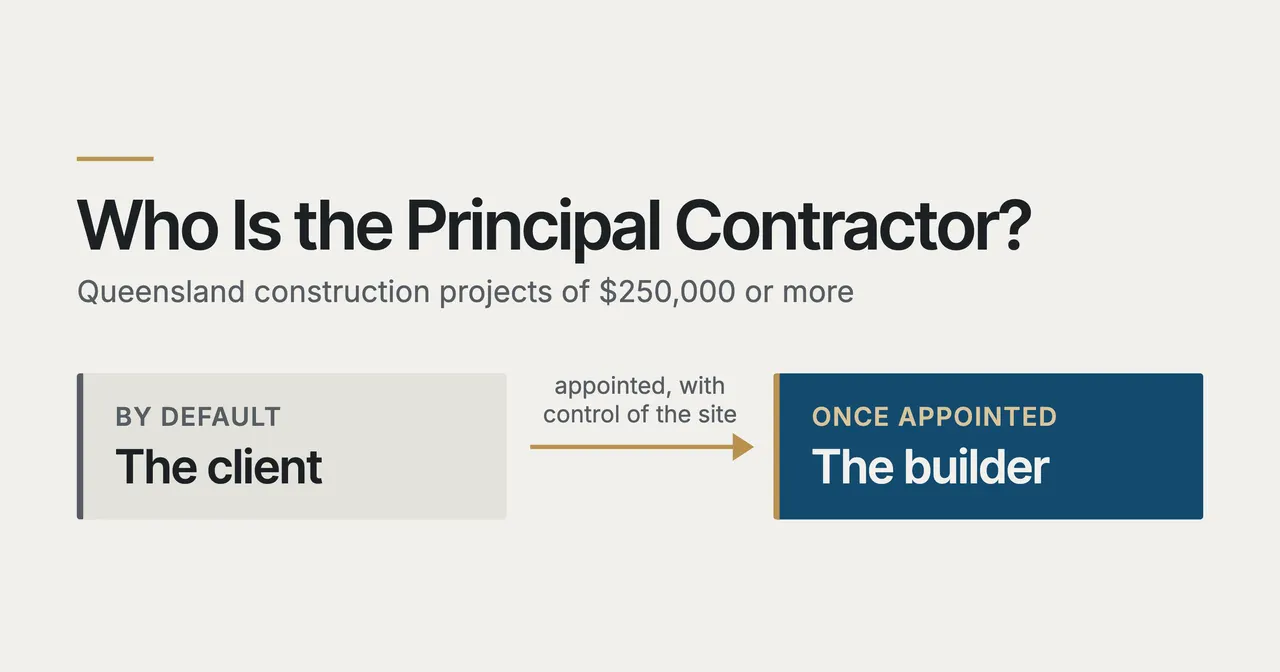
On a Queensland construction project, the client is the principal contractor unless it hands the role to someone else. Under the Work Health and Safety Regulation 2011, a business or agency that commissions construction work costing $250,000 or more takes on the principal contractor's duties by default. To pass them on, it must engage another business as principal contractor and authorise it to manage or control the workplace. Even then, the client keeps safety duties of its own.
This article covers when a job becomes a construction project, how the appointment works, what a principal contractor must do and what stays with the client. It is written for facility owners, developers and agencies commissioning commercial work in Queensland. An individual having work done on their own home is covered by a separate rule and is not discussed here.
When Is a Job a Construction Project?
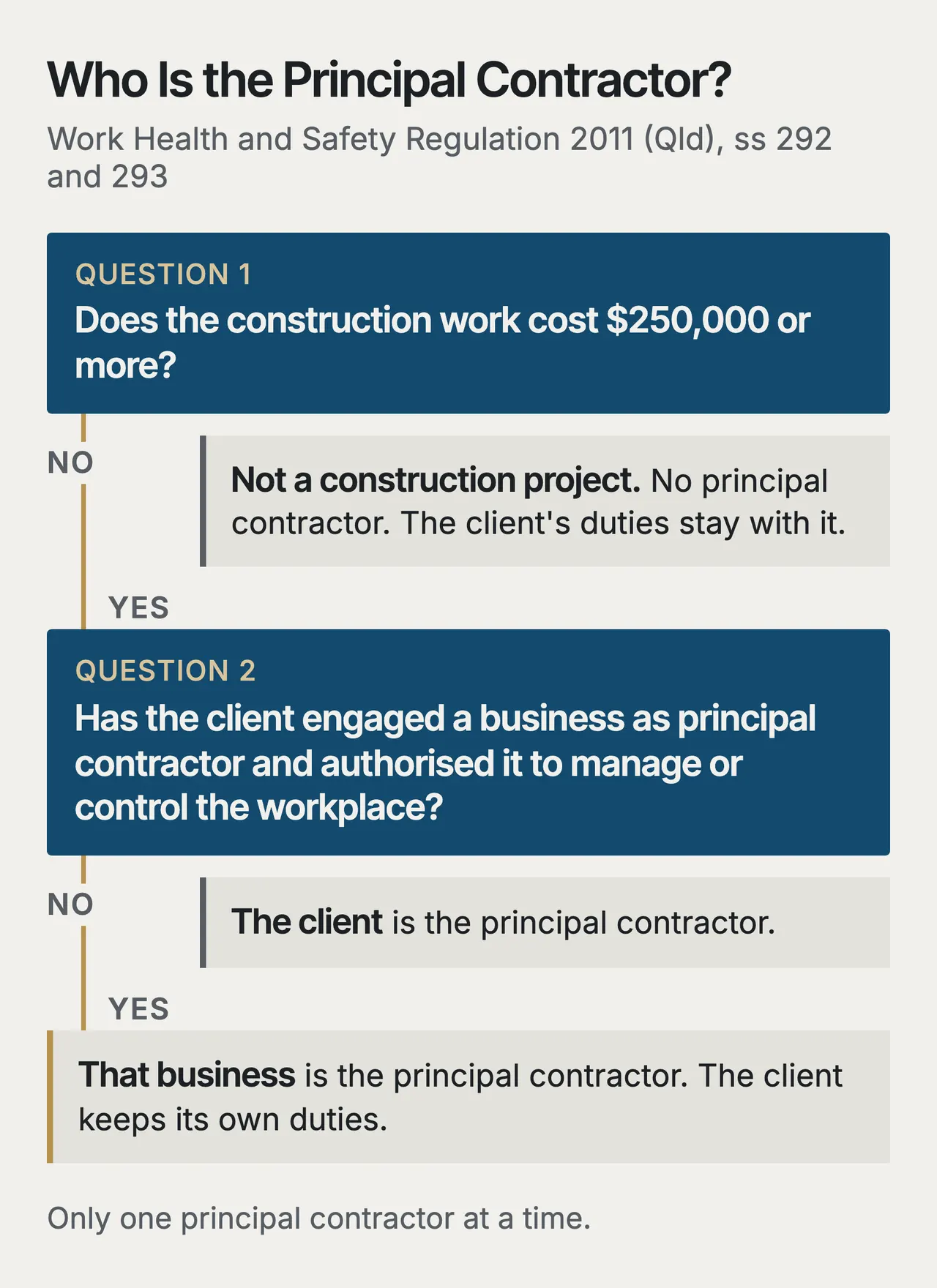
A construction project is a project involving construction work that costs $250,000 or more (section 292 of the regulation). Construction work is broad. It includes building, alteration, fit-out, refurbishment, repair, maintenance and demolition, and the site preparation that goes with them (section 289).
WorkSafe Queensland says the cost can be worked out from the contract price. It includes project management costs, fittings and furnishings, and taxes, levies and charges, but not GST.
Below $250,000, the job is not a construction project and no principal contractor can be appointed. A client can still authorise a contractor to manage or control the work area. WorkSafe Queensland is clear, though, that doing so does not transfer the client's own duties.
The Client Is the Principal Contractor by Default
Section 293 sets the rule in two steps.
- The business or undertaking that commissions a construction project is the principal contractor.
- If that client engages another business as principal contractor, and authorises it to have management or control of the workplace and to carry out the principal contractor's duties, the business engaged becomes the principal contractor.
A project has only one principal contractor at any time. A client that does nothing, or engages a builder without handing over control of the site, stays in the role. For a hospital, school, council or company commissioning a refurbishment, that means the safety plan, the site signs, collecting the safe work method statements and the site amenities are all its responsibility.
How to Appoint a Principal Contractor
The regulation asks for two things: the engagement, and the authority to manage or control the workplace. It does not prescribe a form. WorkSafe Queensland recommends that the appointment be documented and signed by the parties, so the roles are clear. We recommend writing it into the building contract.
A written appointment should:
- Name the principal contractor and the project.
- Describe the workplace it controls, with a site plan showing the boundary.
- Authorise it to have management or control of that workplace and to discharge the principal contractor's duties under chapter 6 of the regulation.
- Say when the appointment starts and ends, including how areas are handed back.
- Set out how the client and the principal contractor will consult, cooperate and coordinate where their activities meet.
There is no need to notify Workplace Health and Safety Queensland of the appointment, although WorkSafe Queensland notes that QLeave, the portable long service leave authority, must still be notified.
Drawing the Line on an Occupied Site
WorkSafe Queensland's position is that only one business can have management or control of a defined workplace at a time. For two projects side by side, WorkSafe Queensland's guidance is to mark where each principal contractor's control starts and ends, ideally with a fence or signs. The same question needs an answer when work happens inside a building that stays open: which areas belong to the principal contractor, and which stay with the facility. Settle it on a drawing before work starts, and update it as areas change hands.
What the Principal Contractor Must Do
Once appointed, the principal contractor carries the duties in part 6.4 of the regulation, on top of its duties as a business working on the site.
| Duty | What It Involves | Section |
|---|---|---|
| Site sign | Its name, phone numbers including an after hours number, and the site office location, visible from outside the site | 308 |
| WHS management plan | A written plan for the workplace, prepared before work on the project starts | 309 |
| Telling workers | Every worker made aware of the plan, and of their right to inspect it, before they start | 310 |
| Keeping the plan current | The plan reviewed and revised as needed, and workers told of changes | 311 |
| Safe work method statements | All reasonable steps to obtain each one before the high risk construction work starts | 312 |
| Workplace arrangements | Arrangements for first aid, emergency plans, protective equipment, falls, falling objects and other listed matters | 314 |
| Specific risks | Materials and waste, plant not in use, traffic near the site, and essential services | 315 |
| Amenities | Toilets, a sheltered area for breaks, washing facilities and drinking water, kept clean and serviceable | 315A and schedule 5A |
Where objects could fall on people, the principal contractor on commercial building work must also put falling-object controls in place, such as hoardings, gantries or closing the adjoining area (sections 315B to 315M).
What Goes in the WHS Management Plan
Section 309 lists what the plan must cover:
- the names, positions and safety responsibilities of the people with specific safety roles on the project
- how the businesses on site will consult, cooperate and coordinate their work
- how incidents will be managed
- the site rules, and how everyone on site is told about them
- how safe work method statements are collected, assessed, monitored and reviewed.
The plan is kept until the project is complete, or for at least two years after a notifiable incident. It must be easy for workers to get to and available to an inspector (section 313).
SWMS and High Risk Construction Work
A safe work method statement (SWMS) is required before any high risk construction work starts, on any job, whether or not it is a construction project (section 299). Section 291 defines high risk construction work in 18 categories.
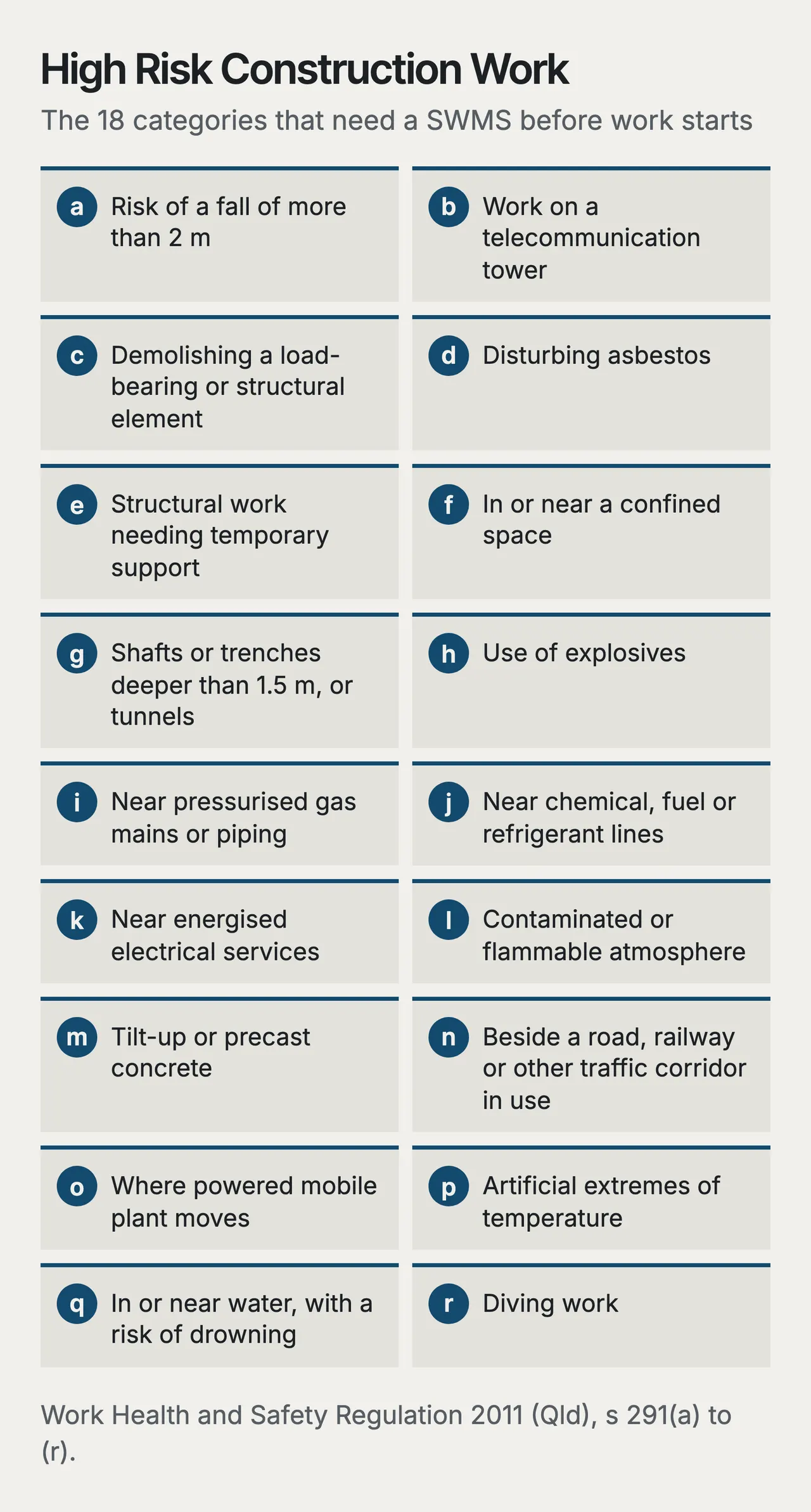
The business doing the work makes sure there is a SWMS, whether it writes one or uses one already prepared. The SWMS identifies the work, the hazards and risks, the controls, and how the controls are put in place, monitored and reviewed. On a construction project it must take account of the WHS management plan, and a copy goes to the principal contractor before the work starts (section 301).
If the work is not being done the way the SWMS says, it must stop and resume only in line with it (section 300). The SWMS is reviewed when the controls change (section 302), and kept until the work is finished, or for two years after a notifiable incident (section 303).
For a client, the point is simple. The principal contractor collects every trade's SWMS before the high risk work begins. If you have not appointed one, that job is yours.
What the Client Still Carries
Appointing a principal contractor moves the chapter 6 duties. It does not move every duty the client has.
The Work Health and Safety Act 2011 says a duty cannot be transferred (section 14), and a contract term that tries to transfer one is void (section 272). The appointment works because the regulation itself names the engaged business as principal contractor. The client's own duties stay with it:
- Its primary duty of care as a business (section 19 of the Act), so far as is reasonably practicable. Where the client and the principal contractor share a duty, each keeps it and must meet it to the extent it can influence and control the matter (section 16).
- The areas it still manages or controls (section 20), such as the rest of an occupied building, shared entries and building services.
- Consulting, cooperating and coordinating with the principal contractor and other duty holders (section 46).
- Passing on what it knows. A client that engages a principal contractor must give it any information it has about hazards and risks at or near the workplace (regulation section 296): an asbestos register, the location of services, or hazardous processes in the building.
- Design risks. The client must, so far as reasonably practicable, consult the designer about risks the design creates during construction (regulation section 294). If it did not commission the design, it must take all reasonable steps to get the designer's safety report (regulation section 295).
- Its officers' due diligence (section 27). Directors and senior managers must take reasonable steps to make sure the organisation meets these duties.
What You Should See on Site
Whoever holds the role, a well-run construction project shows these things:
- A written appointment that names the principal contractor and defines the workplace it controls.
- A sign at the entry with the principal contractor's name and phone numbers, including after hours.
- A WHS management plan, ready before work starts, with the site rules.
- Inductions, so every worker knows the plan and the rules. Every worker also needs general construction induction training, the white card (sections 316 and 317).
- A SWMS for each high risk activity, collected before that work starts.
- A site secured against people who should not be there (section 298).
- Toilets, drinking water, washing facilities and a place to take breaks.
If any of these is missing, ask who the principal contractor is. For a question about your own project, WorkSafe Queensland or a workplace safety lawyer can give specific advice.