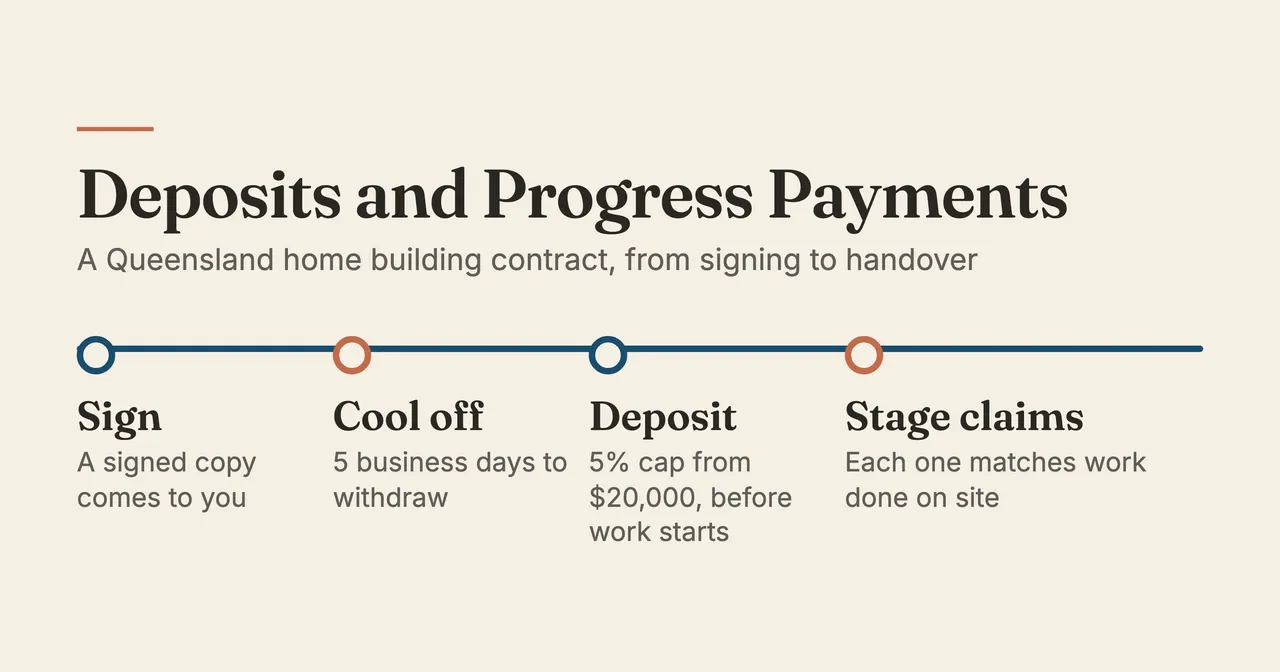
In Queensland, the deposit on almost every home build or renovation is capped at 5% of the contract price: that is the limit for any home building contract of $20,000 or more. A 10% deposit is allowed only on small jobs over $3,300 and under $20,000, and 20% only where work made off site is worth more than half the contract price. After the deposit, each progress claim must be tied to work actually done at the building site, so work made off site cannot be claimed until it is installed, and in practice nor can materials delivered but not yet fixed in place. You also have five business days after you receive the signed contract to change your mind. These rules are set by schedule 1B of the Queensland Building and Construction Commission Act 1991 (the QBCC Act), and they apply whoever your builder is.
This guide sets out each rule as it stands on 2 October 2026, what a typical payment schedule looks like for a new home or a renovation, and what to check before you pay a claim.
How Much Deposit Can a Builder Ask For in Queensland?
The Act calls a home building contract over $3,300 a regulated contract, and splits regulated contracts into two levels. Almost every new home, extension or renovation is a level 2 contract, so the 5% cap is the one that applies. A contract of $3,300 or less sits outside these rules.
| Contract price | Contract level | Most the builder can take as a deposit |
|---|---|---|
| $20,000 or more | Level 2 | 5% |
| Over $3,300 and under $20,000 | Level 1 | 10% |
| Level 1 or 2, with more than half the value made off site | Level 1 or 2 | 20% |
Three details catch people out:
- A deposit is any payment before work starts on site, not only the line marked "deposit". The Act gives the home warranty insurance premium as an example, so the premium sits inside the cap, not on top of it.
- The 20% exception is narrow. It applies only when work made somewhere else and installed later is worth more than half the contract price. QBCC's examples of this made-to-measure off-site work are kitchen modules and cabinetry, windows, sheds, pergolas and cladding. On a typical home build or renovation, most of the work happens on site, so the 5% cap stands.
- On a cost plus contract, the builder's estimated amount stands in for the contract price when working out the cap.
For a regulated contract, asking for or taking more than the cap is an offence for the builder. It can also cost you protection. If a builder fails to finish and you claim under the Queensland Home Warranty Scheme (non-completion cover is for fixed price contracts only), QBCC will only cover the deposit the builder was lawfully allowed to charge.
When Can a Builder Claim a Progress Payment?
After the deposit, the Act lets a builder claim an amount only if it is:
- directly related to the progress of the work at the building site, and
- proportionate to the value of the work the claim relates to, or less than that value.
The Act gives its own example: a builder can claim half the contract price, less a 5% deposit, after half of the work is complete.
The law does not fix the number of claims or what the stages are. You and your builder agree them in the contract, as long as each claim keeps step with the work. QBCC describes two common approaches: payments at construction milestones, such as the slab, frame and roof, or payments at regular intervals backed by evidence of the value of work done.
No Claims for Unfixed Materials or Off-Site Work
Every claim must relate to the progress of the work at the building site, and the Act says the building site does not include the place where off-site work is done. So cabinetry being made in a workshop or windows being fabricated in a factory cannot be claimed until they are installed at your home. The industry reads section 34 the same way for materials delivered to site: timber, fittings and plant that are not yet fixed in place are not claimed until they are. That is also why the Act allows a higher deposit, up to 20%, where most of the work is made off site.
A Typical Stage Schedule for a New Home
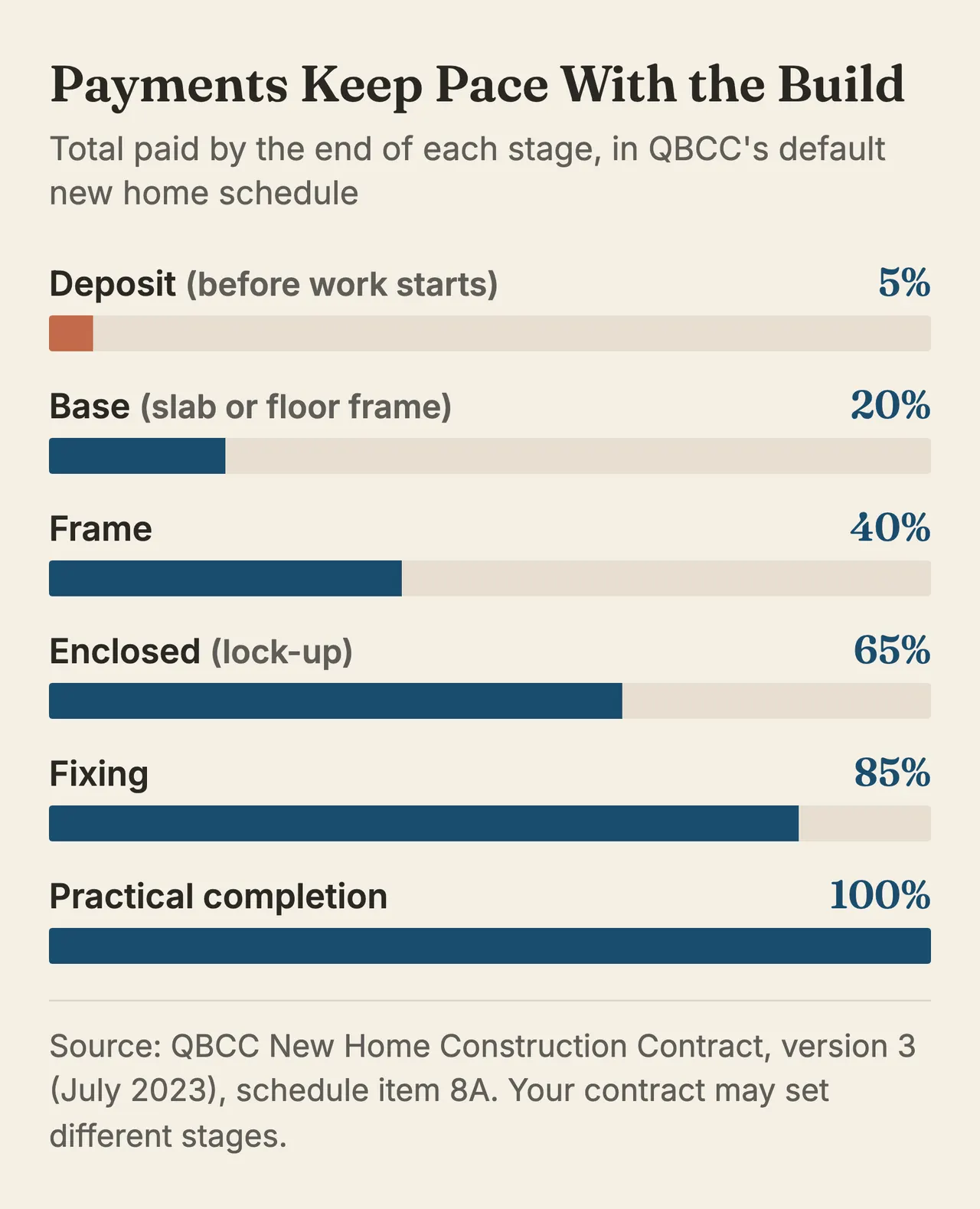
QBCC's own New Home Construction Contract (version 3, July 2023) offers a default schedule that many contracts follow or adapt.
| Stage | Share of the contract price | When the stage is reached |
|---|---|---|
| Deposit | 5% | On signing, before work starts on site |
| Base | 15% | Footings and slab, or stumps, bearers and joists, are finished and ready for the walls |
| Frame | 20% | The frame is complete and ready for the certifier's inspection |
| Enclosed | 25% | Cladding, roof, structural floor, and external doors and windows are fixed |
| Fixing | 20% | Internal linings, doors, skirtings, wet area tiling and built-in cabinets are fitted |
| Practical completion | 15% | The work is finished to the contract, apart from minor defects or omissions that will not unreasonably affect living in the home |
The same contract tells builders to use a different schedule where these percentages would mean being paid ahead of the work on site.
Renovations and Extensions
A renovation rarely runs slab, frame, lock-up in a neat line, so its stages are usually written around the job itself. A kitchen and bathroom renovation, for example, might be staged at demolition, rough-in, waterproofing and tiling, joinery, and completion. The test does not change: each claim should match work you can see on site, and the running total should never get ahead of it.
A Variation Can't Be Charged Before the Work Starts
A variation is any change to the work or materials after you sign. Under the Act, the builder needs your written agreement before starting varied work, must give you a copy of the variation in writing, and cannot require you to pay a price increase before the varied work has started. When a claim includes variations, each one should match a variation you have signed.
The Five Business Day Cooling-Off Period
Under any regulated contract, you can withdraw within five business days after the day you receive a copy of the signed contract from the builder. For a level 2 contract, if the QBCC Consumer Building Guide reaches you after the signed contract, you have five business days from the day you receive the guide. If five business days pass after signing and the builder still has not given you these documents, you can withdraw.
To withdraw, give the builder a signed written notice saying you withdraw from the contract and naming the section you rely on, section 35 of schedule 1B. The builder can keep any out-of-pocket expenses it reasonably incurred before you withdrew, plus $100 if you withdraw within five business days of receiving the signed contract, and must refund the rest of anything you have paid. If you have paid less than the amount the builder can keep, you pay the builder the difference.
You cannot use the cooling-off period if, before signing, you received independent legal advice on the contract from a lawyer you paid, or you tell the builder you did. Nor can you use it if the contract replaces an earlier one with the same builder on substantially the same terms, for substantially the same work on the same home or land. On a contract for repairs, you can choose to waive the right in writing.
What to Check Before You Pay a Claim
QBCC's advice is short: don't pay more, or earlier, than your contract says. In practice, that means five checks each time a claim arrives.
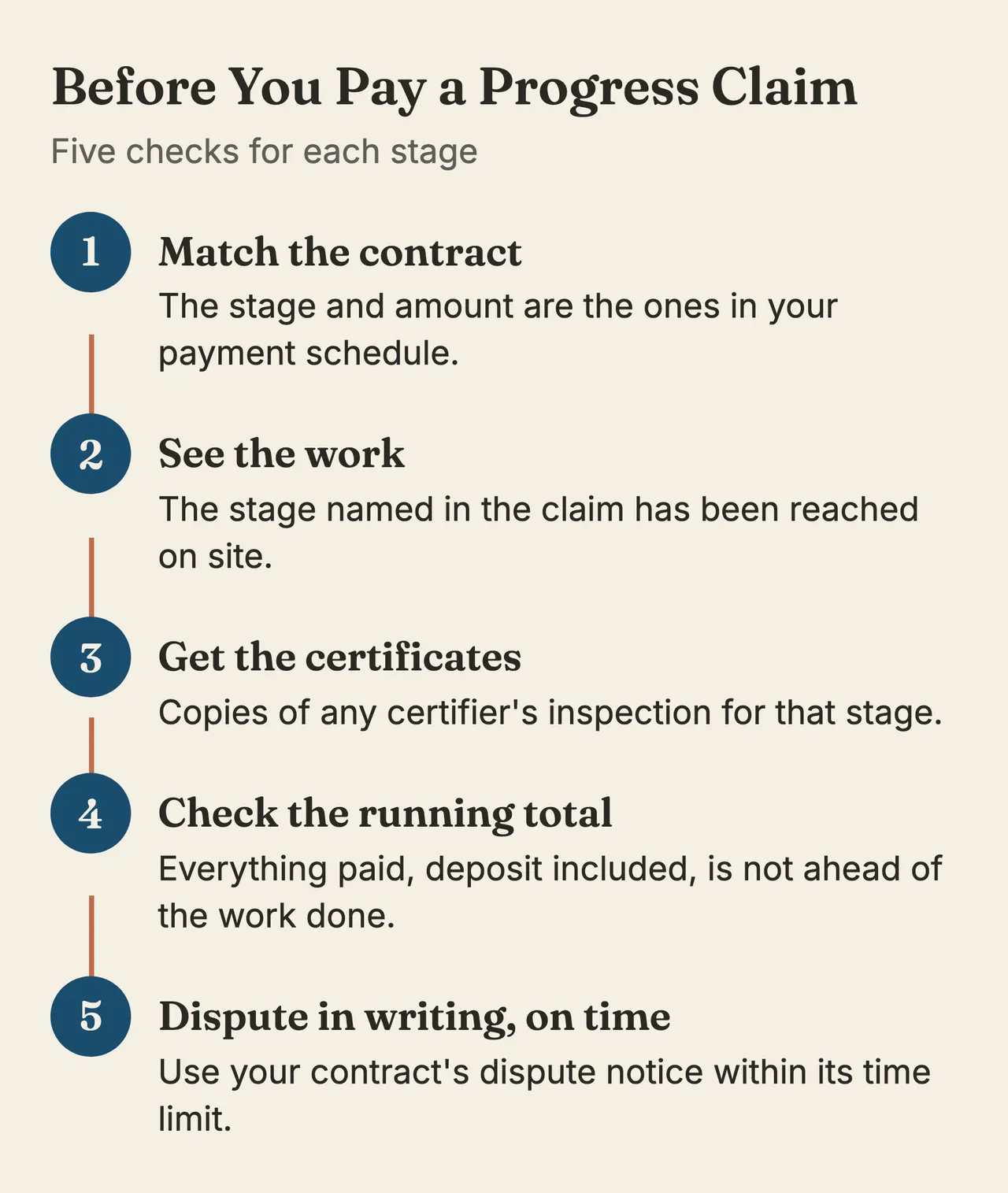
- Match the claim to the contract. The stage and the amount should be the ones in your payment schedule.
- See the work. Walk the site with your builder, or ask an independent building inspector, and confirm the stage named in the claim has been reached.
- Get the inspection certificates. Where your builder engaged the certifier, the Act requires the builder to give you a copy of each certificate of inspection as soon as practicable after receiving it. QBCC's new home contract also has each claim come with any certificates of inspection for that stage, so a frame claim should line up with the frame inspection.
- Check the running total. Add the claim to everything already paid, deposit included. The total should not run ahead of the share of the work that is done. Any adjustments for prime cost items and provisional sums should show the actual cost against the allowance.
- Dispute in writing, on time. If something is not right, use your contract's dispute process within its time limit. QBCC's new home contract, for example, gives an owner five business days from receiving a claim to pay the part that is not disputed and to give written notice of what is disputed and why.
The last payment waits for practical completion. You do not have to make the final payment until the work is finished to the contract and all legal requirements, with at most minor defects or omissions that will not unreasonably affect living in the home. If you point out minor defects or omissions, the builder must give you a defects document that lists them.
Paying early carries a cost of its own. If the builder fails to finish and you have paid for work ahead of the schedule, the Home Warranty Scheme will only pay what you would have lost had you kept to the schedule.
If Something Does Not Look Right
Raise a deposit above the cap, or a claim that runs ahead of the work, with your builder in writing first. For a dispute you cannot settle, QBCC's dispute resolution service or a construction lawyer can advise on your situation.
Clear payment stages are one of the simplest protections in a building contract. Read the schedule before you sign, ask what each stage means on your job, and match every claim to the work in front of you.