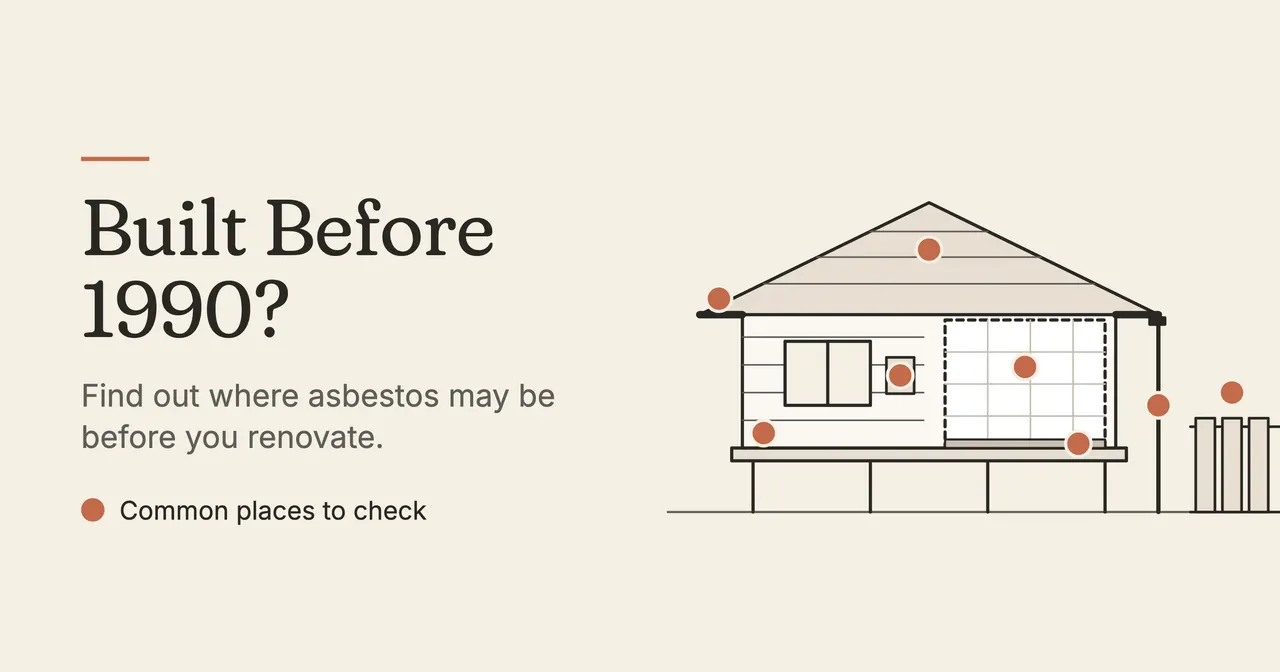
If your Queensland home was built before 1990, there is a good chance it contains asbestos, most often as fibro sheeting in the bathroom, laundry, kitchen, eaves and roof. Left alone in good condition, it is not a health risk. The risk comes when it is cut, drilled, broken or removed, which is what a renovation does. So before you renovate, find out what is there, treat anything you are unsure of as asbestos until a laboratory has tested it, and have a licensed asbestos removalist take it out, whatever the amount. The law sets the minimum: a builder needs a licensed removalist for more than 10 square metres of bonded asbestos, a homeowner doing their own removal needs a certificate above that amount, and any friable asbestos needs a class A licence. On our renovations, a licensed removalist removes all of it, because a small amount releases the same kind of fibres and deserves the same care.
The rules below are as at 2 October 2026.
Which Queensland Homes Are Likely to Contain Asbestos
The Queensland Government gives a rule of thumb based on when a home was built.
| When the Home Was Built | Asbestos-Containing Materials |
|---|---|
| Before the mid-1980s | Highly likely |
| Mid-1980s to 1990 | Likely |
| After 1990 | Highly unlikely |
Asbestos and products containing it have been banned throughout Australia since 31 December 2003, so new building materials do not contain it. The age of a house is a guide, not a test.
Where Asbestos Is Found in a House
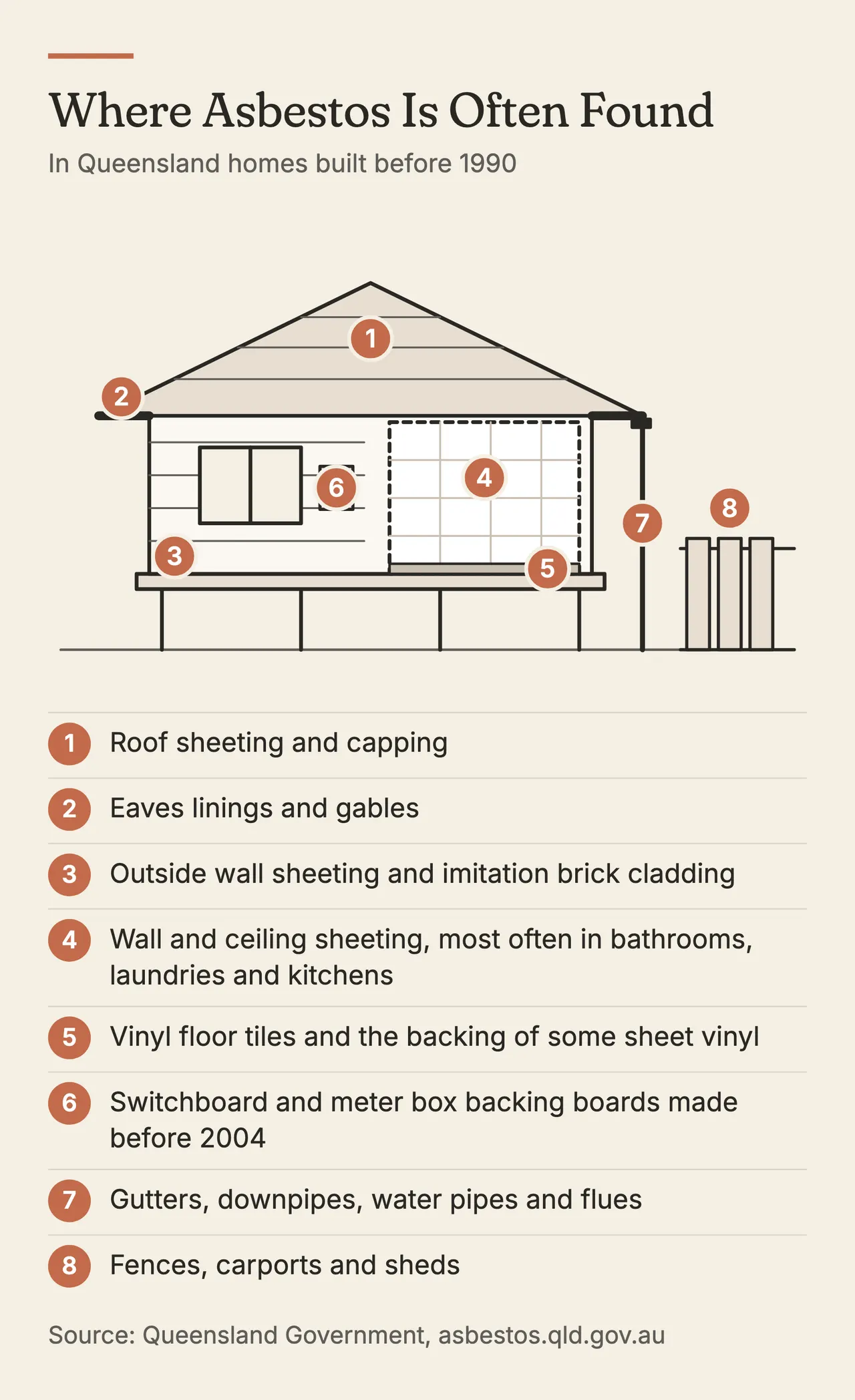
Most asbestos in Queensland houses is non-friable, also called bonded: the fibres are set firmly in cement or another binder. Fibro, asbestos cement and AC sheeting are the common names. The Queensland Government lists these as the usual places to find it.
- Wet areas: wall and ceiling sheeting in bathrooms, laundries and kitchens, often tiled over.
- Dry rooms: wall and ceiling sheeting in bedrooms and living rooms.
- Floors: vinyl floor tiles, and the backing of some sheet vinyl and linoleum (friable, see below).
- Roof and eaves: roof sheeting and capping, gables, and eaves linings.
- Outside walls: flat or weatherboard-style sheeting, and imitation brick cladding.
- Pipes and gutters: guttering, water and drainage pipes, and flues.
- Electrical: backing boards in switchboards and meter boxes made before 1 January 2004.
- Around the yard: fences, carports and sheds.
- Finishes: textured paint and plaster patching compounds.
Some materials are friable: they crumble to powder by hand when dry and release fibres much more easily. In homes, the government points to the felt backing of some sheet vinyl and linoleum, some felt carpet underlay, old heater and stove linings, and low density asbestos fibre board, a soft board that looks like fibro or plasterboard but dents under light pressure. Friable asbestos may only be removed by the holder of a class A asbestos removal licence.
Is Asbestos in Your Home Dangerous?
The Queensland Government's position is that living in a building that contains asbestos is not dangerous as long as the asbestos is in good condition. The risk comes when it is worked on or disturbed and fibres get into the air and are breathed in. The more fibres breathed in, and the more often, the higher the risk. Breathing in asbestos fibres is linked to three diseases, asbestosis, lung cancer and mesothelioma, which usually appear at least 10 years after exposure. Occasional low exposures, such as from renovation work on a neighbouring property, are likely to carry a low risk.
Where sound asbestos sits outside the work, the government notes that leaving it alone is sometimes the safest option.
Look, Check and Prepare Before You Start
The government's advice to homeowners comes down to three steps.
- Look. Use the age of the house and the list above to work out where asbestos is likely to be in the areas the work will touch.
- Check. If you are not sure whether a material contains asbestos, assume it does until an accredited laboratory has tested a sample. Laboratories accredited by the National Association of Testing Authorities (NATA) test building materials. Taking a sample disturbs the material, so the government recommends a competent person, such as an asbestos consultant, does it.
- Prepare. Plan the work so fibres stay out of the air, and tell your neighbours what is happening.
What a Homeowner May and May Not Do
When you work on your own home with no business engaged, including as an owner-builder, the Public Health Regulation 2018 applies, and your local council enforces it.
| Material | What the Law Requires |
|---|---|
| Bonded asbestos, 10 square metres or less | No certificate, but safe work procedures and precautions must be followed |
| Bonded asbestos, more than 10 square metres | Each person removing it must hold a certificate gained under arrangements approved by Queensland Health |
| Friable asbestos, any amount | Removal only by the holder of a class A asbestos removal licence |
As a guide, 10 square metres is about four sheets of asbestos cement wall sheeting, or usually one wall of an average bathroom. The approved certificate courses are listed on the Queensland Government's homeowner's certificate page.
Some methods are banned outright. In your own home you must not:
- use power tools such as angle grinders, circular saws or electric sanders to cut or clean asbestos (a battery drill running under 650 rpm is the exception);
- clean asbestos with a high-pressure water blaster;
- use compressed air to clean asbestos, or a surface where asbestos is present;
- sell or give away asbestos you have removed.
The law also requires reasonable measures to keep fibres out of the air, such as wetting the material and wearing protective equipment, and any broken edge left in place must be sealed. The government warns never to use a household vacuum cleaner on asbestos, even one with a HEPA filter.
The law lets you remove a small amount yourself. Our advice is not to. Removal is the part of an asbestos job most likely to release fibres, and 10 square metres is usually a whole bathroom wall. A licensed removalist brings the equipment, the controls and proper disposal.
What Changes When You Engage a Builder
Once a builder or another business is doing the work, your home is also their workplace, and the Work Health and Safety Regulation 2011 applies to them. It sets the legal floor.
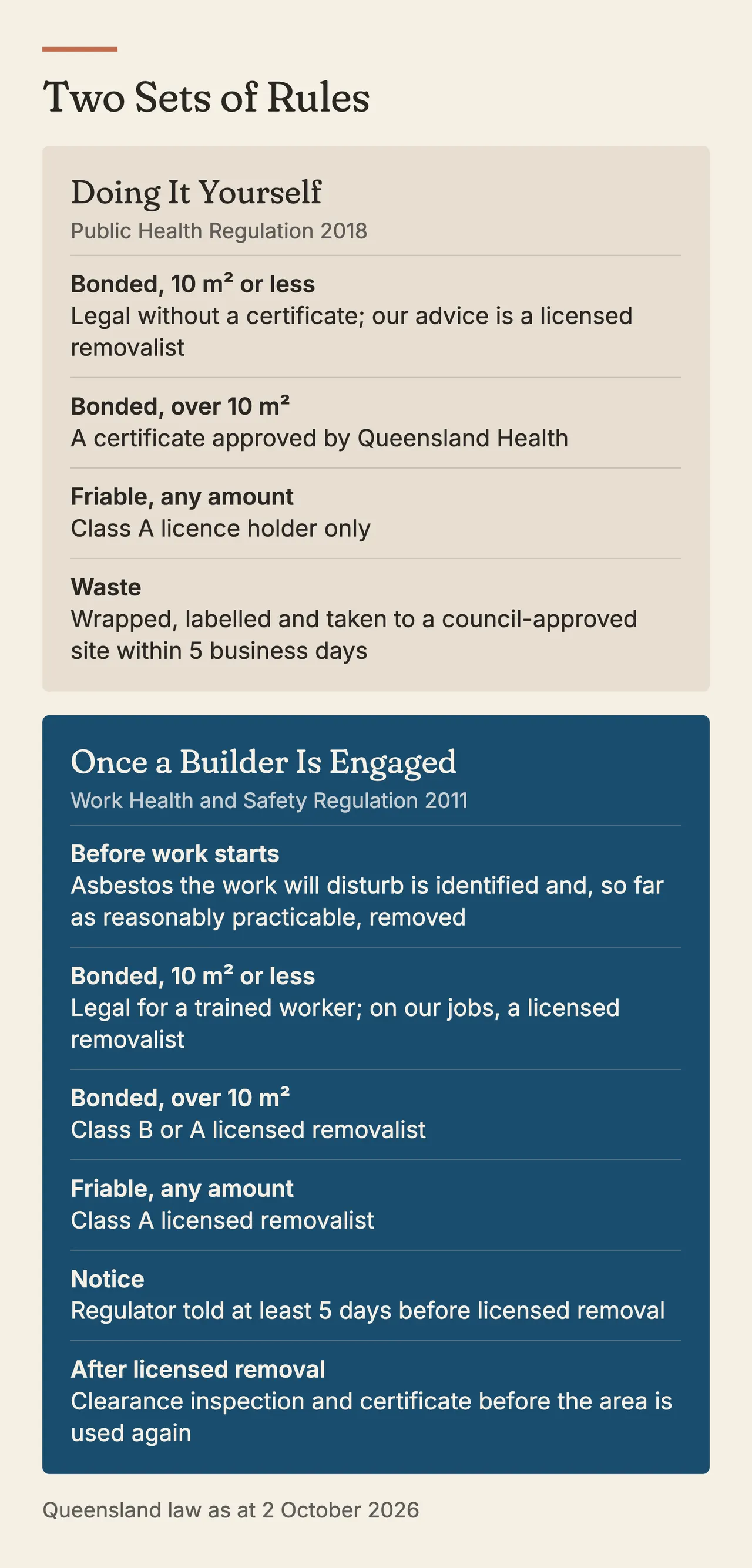
- Identify and remove first. A business carrying out a renovation of a home must ensure all asbestos likely to be disturbed by the work is identified and, so far as reasonably practicable, removed before the renovation starts (section 457). Demolishing a home carries the same duty (section 453).
- A licence above 10 square metres. Removing more than 10 square metres of bonded asbestos at a workplace needs a class B or class A licence, and removing any friable asbestos needs a class A licence (sections 485 and 487). A business that commissions the removal must make sure a removalist licensed for that work does it (section 458).
- Conditions below that line. The law allows 10 square metres or less of bonded asbestos to be removed without a licence, by a competent person trained for the work (section 458), under a written safe work method statement.
- Notice before work starts. The licensed removalist must notify Workplace Health and Safety Queensland at least five days before starting (section 466). At a home, they must also tell the owner, the occupier and neighbouring occupiers, among others, so far as reasonably practicable (section 467).
- A controlled work area. Signs and barricades mark the removal area (section 469), and access is limited, so far as reasonably practicable, to the people doing the work and others the law allows (section 470).
Together, these put asbestos at the front of the renovation programme: identified, removed and cleared before the strip-out starts.
The Standard We Work To
On our jobs, a licensed asbestos removalist removes all of the asbestos, whatever the amount. That is standard practice for careful builders, and it is ours. The reason is simple: a small amount of fibro releases the same kind of fibres as a large one. A licensed removalist brings the controls, a written removal plan, proper disposal and, where the law requires one, a clearance inspection. The Queensland Government's tips for homeowners hiring a contractor point the same way: use a licensed asbestos removal contractor, ask for a copy of the licence and check it with Workplace Health and Safety Queensland.
Ask any builder who will remove the asbestos on your job.
The Clearance Certificate
After licensed removal, the area must be inspected before anyone uses it again. At a home, the licensed removalist must make sure a clearance inspection is carried out (section 473): by an independent licensed asbestos assessor after class A work, or by an independent competent person after class B work.
The assessor or competent person must then issue a written clearance certificate before the area is reoccupied (section 474). A certificate may be issued only when the removal area and the area around it are free of visible asbestos contamination and any air monitoring shows fewer than 0.01 fibres per millilitre. Ask for a copy.
No written clearance certificate is required after removing 10 square metres or less of bonded asbestos without a licence, but the area must still be cleaned of dust and debris before it is used again.
Disposing of Asbestos Waste
Asbestos waste is regulated waste in Queensland. It is illegal to put it in a household bin, or to reuse, recycle or dump it.
If you remove asbestos yourself, the Public Health Regulation 2018 requires you to package and dispose of the waste as soon as practicable, and within five business days. The waste must be:
- double wrapped in plastic sheeting at least 0.2 mm thick, or double bagged in plastic bags at least 0.2 mm thick and no larger than 1200 mm by 900 mm, and sealed with tape;
- labelled with a clear warning that it contains asbestos and that damaging the packaging and breathing the dust should be avoided;
- taken to a disposal site approved by a local council to accept asbestos.
Ring the site first; larger loads also carry transport rules. When a licensed removalist does the job, the removalist must contain and label the waste before it leaves the removal area and take it to a site authorised to accept it.
Before You Renovate
For a home built before 1990, find out what is there before the work is designed and priced, have anything uncertain tested, and plan any removal before the build, not during it. For asbestos complaints and urgent enquiries, call the Queensland Government on 13 QGOV (13 74 68); your local council can advise on disposal.